.png)
What is AIS Mismatch and Why You May Receive an Income Tax Notice
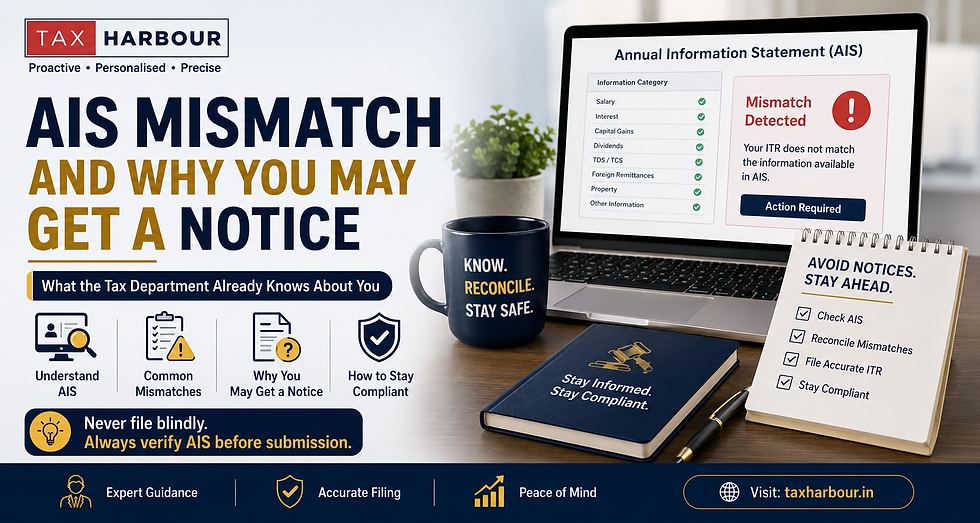
Most taxpayers file their ITR assuming the numbers in Form 16 or bank statements are enough.But today, the Income Tax Department already has access to a much larger financial picture through something called the AIS (Annual Information Statement).
And if your Income Tax Return (ITR) does not match the information available in AIS, you may receive a tax notice.
Understanding AIS has now become one of the most important parts of accurate tax filing — especially for NRIs, investors, and seafarers dealing with multiple financial transactions.
What is AIS (Annual Information Statement)?
AIS is a detailed financial statement available on the Income Tax Portal that shows the information the tax department already knows about you.
It includes data collected from:
Banks
Mutual fund houses
Stock brokers
Employers
Property registrars
Foreign remittance reporting systems
TDS/TCS filings
Government reporting agencies
In simple words:
AIS is your financial activity report card in the eyes of the Income Tax Department.
Why AIS Matters While Filing ITR
When you file your Income Tax Return, the department compares your ITR with the information reflected in AIS.
If there is a mismatch, your return may get flagged for review or automated notices may be issued.
This is why many taxpayers receive notices even when they did not intentionally hide anything.
Common AIS Mismatches That Trigger Notices
1. Interest Income Not Reported
Banks report savings account interest and fixed deposit interest directly to the tax department.
Many taxpayers forget to include:
Savings account interest
FD interest
Recurring deposit interest
Even small omissions can create mismatches.
2. Stock Market Transactions Missing
If you trade in:
Shares
Mutual funds
ETFs
your broker reports transactions to the department.
Common mistakes:
Forgetting intraday trading income
Ignoring capital gains
Reporting incorrect purchase/sale values
3. Foreign Remittances Ignored
This is especially common among:
NRIs
Seafarers
Individuals receiving overseas income
Large inward foreign remittances may appear in AIS.
If your ITR does not properly explain the source, it may attract scrutiny.
4. High-Value Transactions Not Disclosed
AIS may also reflect:
Property purchases
Credit card payments
Large cash deposits
Foreign travel expenses
If your declared income appears inconsistent with these transactions, the department may ask questions.
Important Thing Most Taxpayers Don’t Know
AIS is Not Always Correct
Yes — AIS itself can contain errors.
Sometimes:
Transactions are duplicated
Wrong PAN gets tagged
Incorrect values appear
Closed accounts still show activity
But here’s the key point:
Even if AIS is wrong, ignoring it is a mistake.
You must either:
Reconcile the mismatch, or
Submit feedback/explanation on the portal
Filing blindly without checking AIS can create avoidable notices later.
What Happens If You Ignore AIS Mismatches?
Possible consequences include:
Section 143(1) mismatch notices
Scrutiny notices
Delays in refunds
Additional tax demands
Interest and penalties
For NRIs and seafarers, unresolved notices can also complicate:
Visa processing
Banking compliance
Property transactions
Future tax filings
How to Avoid AIS-Related Tax Notices
Before filing your ITR:
✔ Download your AIS from the Income Tax Portal ✔ Match all income entries carefully ✔ Verify capital gains and interest income ✔ Reconcile foreign remittances properly ✔ Correct errors through AIS feedback if needed ✔ File only after verification
Final Takeaway
AIS has changed how tax compliance works in India.
Today, the Income Tax Department already has access to most of your financial data.The safest approach is no longer just filing an ITR — it is filing a properly reconciled ITR.
Never file blindly. Always verify AIS before submission.
At Tax Harbour, AIS reconciliation is part of every return we handle — because one mismatch today can become a notice tomorrow.
🌐 Visit: taxharbour.in


Comments