.png)
₹6.8 Lakh Trading Income Yet Tax Payable? The Mistake Most Traders Make | Tax Harbour
Introduction:
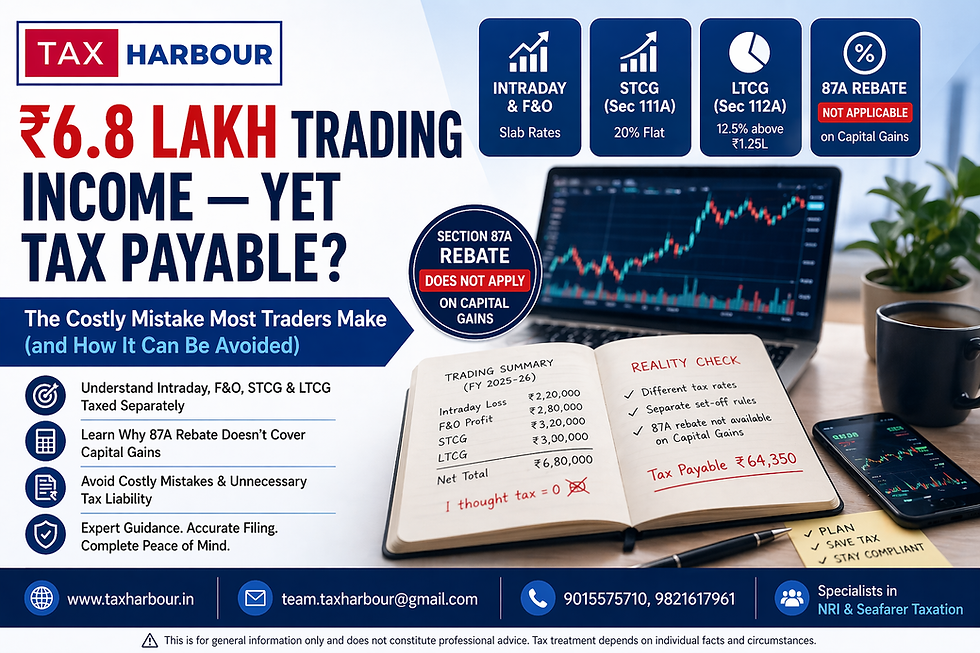
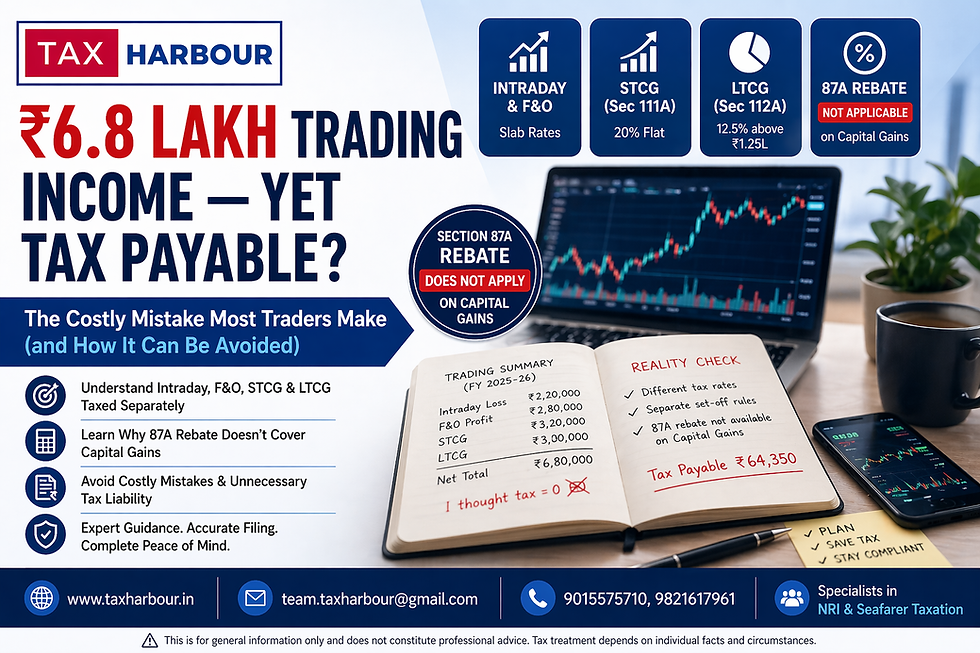
You sit down to file your Income Tax Return at the end of the year. Your total trading income adds up to ₹6.8 lakh. You know the new tax regime offers full relief up to ₹12 lakh. You expect zero tax. Then the ITR computation screen shows tax payable.
It is a shock that thousands of active traders across India face every year. The mistake is not a wrong number. It is a wrong assumption: that all income is treated the same.
In this article, Tax Harbour walks you through exactly what happened to Aman, a trader who found himself in this situation, and how the tax liability could have been avoided with the right planning.
Meet Aman: The Trader Who Thought He Owed Nothing
Aman is a salaried professional who actively trades in equities and derivatives on the side. At the end of FY 2025-26, he tallied his trading income:
Income Type | Amount |
Intraday Trading | Loss of ₹2,20,000 |
F&O (Futures and Options) Profit | ₹2,80,000 |
STCG (Short-Term Capital Gains) | ₹3,20,000 |
LTCG (Long-Term Capital Gains) | ₹3,00,000 |
Aman’s calculation: ₹2.8L + ₹3.2L + ₹3L minus ₹2.2L = ₹6.8L. "Well below ₹12 lakh. Zero tax."
Wrong. That is not how trading income is taxed. And this misunderstanding cost Aman ₹64,350. |
The Core Rule: Every Income Head Is a Separate Compartment
Indian income tax law does not allow you to add up all your trading income and compare it to the exemption limit. Each type of income lives in its own compartment, with its own tax rate, its own set-off rules, and its own rebate eligibility.
Think of it as four separate tax buckets that never mix:
Income Type | Tax Rate | Loss Set-Off | Carry Forward |
Intraday (Speculative) | Slab rates | Only against speculative profit | 4 years |
F&O (Non-Speculative Business) | Slab rates | Against any income except salary | 8 years |
STCG (Section 111A) | 20% flat | Against STCG and LTCG | 8 years |
LTCG (Section 112A) | 12.5% above ₹1.25L | Only against LTCG | 8 years |
Breaking Down Each Income Type
1. Intraday Trading = Speculative Business Income
Intraday trades, where you buy and sell shares on the same day, are classified as speculative business income under the Income Tax Act.
• Taxed at your applicable slab rate
• Losses can ONLY be set off against speculative profits in the same or future years
• Cannot be set off against F&O profit, STCG, LTCG, or salary
• Can be carried forward for 4 years
Aman’s ₹2,20,000 intraday loss: Since he has no other speculative income this year, this loss is carried forward. It cannot reduce his F&O profit or capital gains.
2. F&O Trading = Non-Speculative Business Income
Futures and Options (F&O) trading is treated as non-speculative business income under the Income Tax Act.
• Taxed at normal slab rates
• Losses can be set off against almost all income types (except salary)
• Can be carried forward for 8 years
• Requires a Tax Audit if turnover exceeds the prescribed threshold
Aman’s F&O Profit ₹2,80,000: This is below the basic exemption limit of ₹4,00,000. Any unused portion of the basic exemption can be applied to reduce taxable STCG. See the calculation below.
3. STCG (Short-Term Capital Gains on Listed Equity) | Section 111A
When you sell listed equity shares or equity mutual fund units within 12 months, the profit is classified as Short-Term Capital Gains under Section 111A.
• Tax rate: 20% flat (increased from 15%, effective 23 July 2024)
• No basic exemption benefit (except to the extent of unused basic exemption from other income)
• STCG losses can be set off against both STCG and LTCG
4. LTCG (Long-Term Capital Gains on Listed Equity) | Section 112A
When you sell listed equity shares or equity mutual fund units after holding them for more than 12 months, the profit qualifies as Long-Term Capital Gains under Section 112A.
• Exemption: ₹1,25,000 per financial year
• Tax rate: 12.5% on gains above ₹1,25,000
• No indexation benefit
• LTCG losses can only be set off against LTCG (not STCG)
The Section 87A Rebate: The Most Misunderstood Rule
This is where the most dangerous misconception lies. Many traders and some tax preparers still believe that if your total income is below ₹12 lakh, the Section 87A rebate will eliminate your tax entirely.
That belief is wrong when your income includes capital gains.
Income Type | 87A Rebate Available? |
Normal income (F&O, salary, etc.) taxed at slab rates | YES – if total normal income is within ₹12L (new regime) |
STCG under Section 111A | NO – not available on special rate income |
LTCG under Section 112A | NO – not available on special rate income |
Even if your total income including STCG and LTCG is below ₹12 lakh, you will pay tax on the capital gains portion at the applicable special rates. The rebate applies only to tax on income computed at slab rates.
Aman’s Correct Tax Calculation | FY 2025-26
Step 1: Intraday Loss (₹2,20,000)
Speculative loss. Cannot be set off against F&O profit or capital gains. Carried forward for 4 years.
Step 2: F&O Profit (₹2,80,000)
Business income taxed at slab rates. Basic exemption limit = ₹4,00,000.
Taxable F&O income: NIL (₹2,80,000 is below the ₹4,00,000 basic exemption)
Unused basic exemption = ₹4,00,000 minus ₹2,80,000 = ₹1,20,000
Step 3: STCG under Section 111A (₹3,20,000)
Unused basic exemption of ₹1,20,000 is applied against STCG first.
Description | Amount |
STCG | ₹3,20,000 |
Less: Unused basic exemption | (₹1,20,000) |
Taxable STCG | ₹2,00,000 |
Tax at 20% | ₹40,000 |
Section 87A Rebate | NIL (not available on STCG) |
Tax Payable on STCG | ₹40,000 |
Step 4: LTCG under Section 112A (₹3,00,000)
Description | Amount |
LTCG | ₹3,00,000 |
Less: Annual Exemption (Section 112A) | (₹1,25,000) |
Taxable LTCG | ₹1,75,000 |
Tax at 12.5% | ₹21,875 |
Section 87A Rebate | NIL (not available on LTCG) |
Tax Payable on LTCG | ₹21,875 |
Step 5: Final Tax Summary
Tax Component | Amount |
Tax on F&O and Normal Income | ₹0 |
Tax on STCG (Section 111A) | ₹40,000 |
Tax on LTCG (Section 112A) | ₹21,875 |
Total Tax Before Cess | ₹61,875 |
Health and Education Cess at 4% | ₹2,475 |
TOTAL TAX LIABILITY | ₹64,350 |
Result: Aman’s total tax liability is ₹64,350 on income he assumed was fully exempt. The intraday loss of ₹2.2L is also carried forward and cannot reduce this year’s tax. |
5 Common Mistakes Traders Make While Filing ITR
✘ Mistake 1: Clubbing all income together and comparing the total with the exemption limit
✘ Mistake 2: Assuming the ₹12L rebate threshold covers capital gains taxed at special rates
✘ Mistake 3: Setting off intraday loss against F&O profit or capital gains (not permitted)
✘ Mistake 4: Claiming Section 87A rebate against STCG or LTCG
The Right Approach: How to Handle Trading Taxes
✔ Classify each income stream correctly before calculating tax
✔ Apply loss set-offs only within permitted categories
✔ Use the unused basic exemption against STCG (this is permitted)
✔ Do not claim 87A rebate against STCG or LTCG
✔ Harvest capital gains strategically to stay within the ₹1.25L LTCG exemption each year
✔ Pay advance tax if total tax liability exceeds ₹10,000 in a year
Frequently Asked Questions
Can I set off my intraday loss against F&O profit?
No. Intraday trading is classified as speculative business. Losses from speculative business can only be set off against speculative profits. F&O trading is non-speculative business income and these two categories cannot be mixed.
Is Section 87A rebate available on STCG from equity?
No. The rebate under Section 87A is not available on income taxed at special rates. This includes STCG under Section 111A and LTCG under Section 112A. Even if your total income including STCG is below ₹12 lakh, you will pay tax on the STCG portion at 20%.
What is the STCG tax rate for FY 2025-26?
STCG on listed equity shares and equity mutual funds (where STT has been paid) is taxed at 20% flat under Section 111A. This rate was revised from 15% effective 23 July 2024 and applies fully for FY 2025-26.
What is the LTCG tax rate and exemption for FY 2025-26?
LTCG on listed equity shares and equity mutual funds above ₹1,25,000 per financial year is taxed at 12.5% under Section 112A. There is no indexation benefit.
Does F&O income require a tax audit?
If your F&O turnover exceeds the prescribed limits, a tax audit under Section 44AB is mandatory. Even below these limits, maintaining books of accounts is strongly advisable.
How Tax Harbour Can Help
At Tax Harbour, we specialise in the tax needs of traders, investors, NRIs, and seafarers. These are taxpayers with complex, multi-headed income structures that most generalist tax firms handle incorrectly.
✔ Correct classification of all trading income heads
✔ Accurate calculation of set-off and carry-forward of losses
✔ ITR filing for intraday, F&O, STCG, and LTCG combined scenarios
✔ Advance tax planning to avoid interest under Sections 234B and 234C
✔ Tax audit support for F&O traders
✔ NRI and seafarer income tax filing
Aman’s tax liability of ₹64,350 could have been significantly reduced with the right planning before the year closed. One consultation with Tax Harbour might have made all the difference. |
Contact Tax Harbour
9015575710, 9821617961


Comments