.png)
Income Tax Clearance Certificate Under Section 420 of the Income Tax Act, 2025 — What You Actually Need to Know
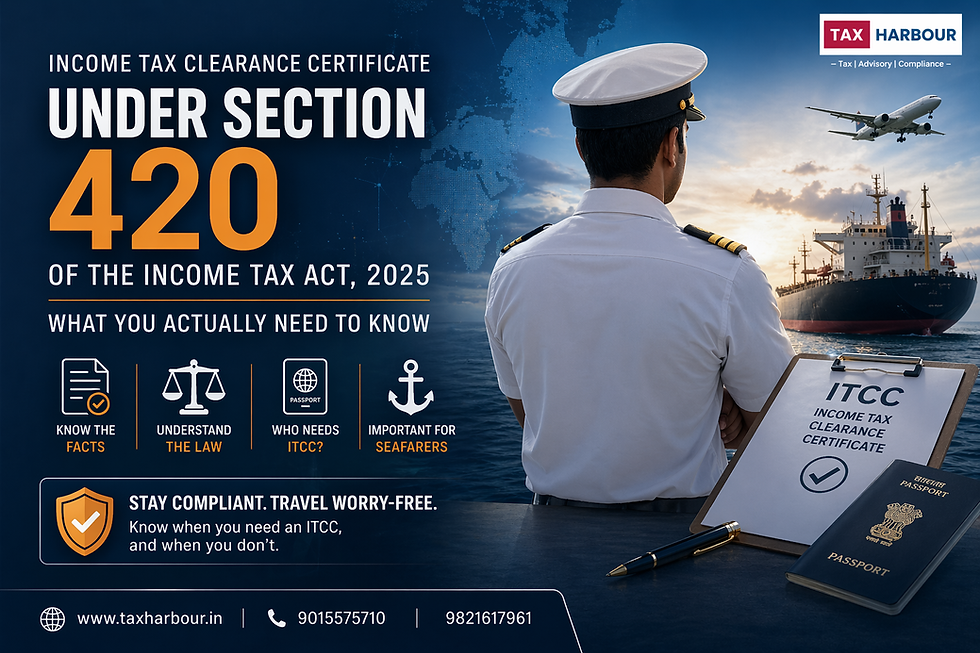
If you have been scrolling through WhatsApp groups or news headlines recently, you have probably come across some version of this alarming claim: "All Indians travelling abroad must now get an Income Tax Clearance Certificate or they cannot board their flight." If that sent you into a mild panic, take a breath because it is not true, at least not in the sweeping way it was portrayed. And if you are a seafarer, this topic is even more directly relevant to your livelihood and day-to-day life.
Let us break this down properly, section by section, without the jargon overload.
What Is an Income Tax Clearance Certificate (ITCC)?
An Income Tax Clearance Certificate (ITCC) is a document issued by the Income Tax Department confirming that a person has either cleared all their tax dues or made satisfactory arrangements to do so. Think of it as a "no dues" certificate from the Revenue Department before a person leaves Indian territory.
Under the old legal framework, this was governed by Section 230 of the Income Tax Act, 1961. With the enactment of the new Income Tax Act, 2025 (effective 1st April 2026), this provision has been re-codified and expanded under Section 420. The change in numbering from 230 to 420 is itself one of the root causes of the public confusion.
Why Everyone Is Suddenly Confused: The Real Story Behind the Panic
The mass confusion erupted in April 2026, when screenshots of what appeared to be a draft government circular went viral on WhatsApp, claiming that blanket ITCC checks would begin at all Indian airports from 1st May 2026. The claim implied that every outbound traveller — tourists, professionals, students, everyone would be stopped at the immigration counter unless they produced a tax clearance certificate.
There are several layers to why this confusion took hold so fast:
1. The Renumbering Factor
The new Income Tax Act, 2025 reorganised the entire statute. What was Section 230 in the 1961 Act has now become Section 420 in the 2025 Act. For anyone who only heard "Section 420", a number deeply associated in Indian culture with fraud under the Indian Penal Code (now Section 318 of the Bharatiya Nyaya Sanhita, 2023), the psychological association immediately triggered alarm. Many people read "Section 420" and assumed something punitive and all-encompassing was being introduced.
2. The Viral Draft Circular
The fake or premature circular that circulated on messaging platforms was not authenticated by the CBDT or the Finance Ministry. However, its official-looking formatting gave it an air of legitimacy. By the time fact-checkers had reviewed it, lakhs of people had already shared it.
3. The 2024 Budget Amendment Hangover
The confusion has a deeper root. In the Finance (No. 2) Act, 2024, the government had amended Section 230 of the old Income Tax Act, 1961 to include persons involved in "serious financial irregularities." That 2024 amendment itself had triggered social media panic, which was debunked at the time by the Press Information Bureau (PIB) Fact Check and the Central Board of Direct Taxes (CBDT). The 2025 Act re-codifying those same provisions gave a second wind to the same misinformation.
4. Misreading Procedural Requirements as Substantive Ones
Section 420(3) of the new Act requires every person domiciled in India to furnish certain details — PAN, purpose of visit, expected duration of stay at departure. Many people conflated this procedural requirement with the requirement to obtain an ITCC. These are entirely different obligations.
What Section 420 of the Income Tax Act, 2025 Actually Says
Let us go through the law directly so there is no ambiguity.
Section 420(1): Who Needs a No-Objection Certificate?
This sub-section applies to a very specific category: non-domiciled persons who came to India for business, profession, or employment and who earned income in India. Such a person cannot leave India by land, sea, or air unless they furnish an undertaking from their employer or the person paying them income, that taxes will be paid. On receipt of this undertaking, the prescribed authority issues a No Objection Certificate (NOC) for departure.
Legal Reference: Section 420(1), Income Tax Act, 2025 (w.e.f. 1st April 2026)
Section 420(2): Foreign Tourists Are Fully Exempt
The statute explicitly excludes tourists and visitors who are not engaged in any business, profession, or employment from the above requirement. If you are a foreign national visiting India for leisure, you are completely outside the scope of Section 420(1).
Section 420(3): The Procedural Requirement for Indian Residents
Every person domiciled in India must, at the time of departure, furnish the following in the prescribed form (Form No. 156 under the new IT Rules, 2026):
Their Permanent Account Number (PAN) allotted under Section 262 of the Act
The purpose of their visit outside India
The estimated period of stay abroad
If a person does not have a PAN, or is not required to have one, they may submit a certificate in the prescribed form (Form No. 157) instead.
This is a procedural furnishing of information not a clearance certificate and not permission to travel. It does not stop ordinary Indians from travelling.
Legal Reference: Section 420(3) & (4), Income Tax Act, 2025; Form No. 156 & 157, Income Tax Rules, 2026
Section 420(5): When Can Authorities Actually Stop You?
This is the provision that really matters for high-risk individuals. An income-tax authority can require a domiciled Indian to obtain a full ITCC before leaving India only if:
"circumstances exist which, in the opinion of an income-tax authority render it necessary for such person to obtain a certificate under this section"
The certificate confirms either that the person has no outstanding tax liability under the Income Tax Act, 2025, the Wealth-tax Act, 1957, the Gift-tax Act, 1958, the Expenditure-tax Act, 1987, or the Black Money (Undisclosed Foreign Income and Assets) and Imposition of Tax Act, 2015 or that satisfactory arrangements have been made for payment.
Section 420(6): The Critical Safeguard — This Is Not Arbitrary Power
This is perhaps the most important sub-section for ordinary citizens to know. An income-tax authority cannot invoke Section 420(5) without:
(a) Recording the reasons in writing, and (b) Obtaining prior approval of the Principal Chief Commissioner or Chief Commissioner of Income Tax
This is not a low-level airport official stopping you on a whim. A senior officer of the rank of PCCIT or CCIT must approve any departure restriction. The CBDT has clarified that this power applies in practice only where:
A person is involved in serious financial irregularities and their departure may prejudice tax recovery, or
There are direct tax arrears exceeding ₹10 lakh that have not been stayed by a court or tribunal
Legal Reference: Section 420(5) & (6), Income Tax Act, 2025
Section 420(7) & (8): Liability on Airlines and Ship Operators
The Act extends responsibility to carriers. If the owner or charterer of a ship or aircraft allows a person who was required to obtain an ITCC to travel without one, they become personally liable for the unpaid tax recoverable as arrears of tax. This is an important provision for shipping companies and airlines to be aware of from a compliance standpoint.
CBDT's Official Clarification: Cutting Through the Noise
The Central Board of Direct Taxes (CBDT) has unambiguously stated that reports of a blanket ITCC requirement for all travellers are factually incorrect. Their position, reiterated multiple times including in response to the April 2026 viral claims, is:
"Every person is not required to obtain a tax clearance certificate. Only certain persons, under specific circumstances, are required to obtain the said certificate."
The PIB Fact Check wing categorised the viral claim as FAKE and traced the confusion to a misreading of both the 2024 amendment to Section 230 and the re-codification in the 2025 Act. Millions of Indians depart the country every day by air, sea, and road without furnishing any clearance certificate whatsoever.
Quick Summary: Who Needs What?
Category | Requirement |
Foreign tourist visiting India | Nothing. Fully exempt under Section 420(2) |
Foreign national in India for employment/business with Indian income | NOC from employer under Section 420(1) |
Indian resident departing abroad (routine travel) | Procedural furnishing of PAN, purpose, duration under Section 420(3) not an ITCC |
Indian resident with pending arrears > ₹10 lakh or serious financial irregularity | ITCC required under Section 420(5), but only with senior approval |
Relevant Forms Under IT Rules, 2026
For reference, the new IT Rules, 2026 prescribe the following forms under Section 420:
Form No. 154 (erstwhile Form 30A) — Undertaking under Section 420(1)
Form No. 155 (erstwhile Form 30B) — No Objection Certificate for non-domiciled persons
Form No. 156 (erstwhile Form 30C) — Details to be furnished under Section 420(3)
Form No. 157 (New Form) — Certificate in lieu of PAN under Section 420(4)
Form No. 158 (erstwhile Form 31) — Application for Certificate under Section 420(5)
Form No. 159 (erstwhile Form 33) — Clearance Certificate under Section 420(5)
How Does This Affect Seafarers? A Note for Merchant Navy Professionals
Seafarers occupy a uniquely complex position under Indian tax law, and Section 420 interacts with their reality in ways that deserve separate attention.
Indian seafarers working on vessels in international waters typically qualify as Non-Residents (NR) for a tax year if they spend fewer than 182 days in India during that year.
However, the new Act's departure provisions can create real practical anxiety for seafarers for the following reasons:
First, a seafarer who has inadvertently acquired resident status in a particular tax year — perhaps due to extended shore leave, medical recovery in India, or delayed sailing — may have taxable global income and outstanding dues without being fully aware of it. If such arrears exceed ₹10 lakh, the Section 420(5) provision could technically apply when they next attempt to sail out.
Second, seafarers often receive income from multiple sources — ship salary, interest on NRE/NRO accounts, capital gains from Indian property and keeping all of these streams tax-compliant requires active attention. Any gap can show up as an arrear.
Third, the "deemed resident" concept introduced from April 2020, which can apply to Indian citizens not liable to tax in any other country with Indian-source income exceeding ₹15 lakh, adds another layer of complexity. Seafarers sailing under flags of convenience from zero-tax jurisdictions need to be particularly vigilant about this.
The good news is that for seafarers who maintain their NRI status properly, file their ITR on time (even if there is no tax payable, filing is strongly advisable for compliance transparency), and have no outstanding dues, Section 420(5) simply does not apply. Their departure to join a vessel is not obstructed. But the viral misinformation around Section 420 has generated real anxiety in the seafaring community — anxiety that timely expert guidance can put to rest.
What Should You Actually Do?
If you are an ordinary Indian traveller, a business professional, or a student going abroad — you do not need an ITCC. Carry your passport, visa, and boarding pass, and you are good to go. Keep your PAN-linked mobile number active; if you do appear on any watch list (which would be exceptional), the authorities will contact you well in advance.
If you are a high-net-worth individual, a businessperson with complex tax profiles, a returning NRI, or a seafarer with multi-jurisdictional income — this is precisely where having a tax advisor who understands these provisions inside out makes all the difference. The law is targeted, not broad; but navigating where you fall requires clarity.
Need Help Understanding Your Tax Position Before Travelling?
At Tax Harbour, we work with individuals, NRIs, seafarers, and businesses to ensure that their tax compliance is in order — so that when they travel, they travel without worry.
Our clients across India trust us for clear, actionable tax advice grounded in the actual law — not social media rumour. We have helped many seafarers and NRIs understand their residential status, file their ITRs correctly, and navigate the complexities of the new Income Tax Act, 2025.
📍 Visit us or leave us a review on Google Maps: Tax Harbour — Google Reviews
We love hearing from our clients — your feedback helps us serve you better.


Comments