.png)
TDS on Rent Exceeding ₹50,000 Per Month — What Every Tenant Must Know in FY 2025-26 | Updated for FY 2025-26

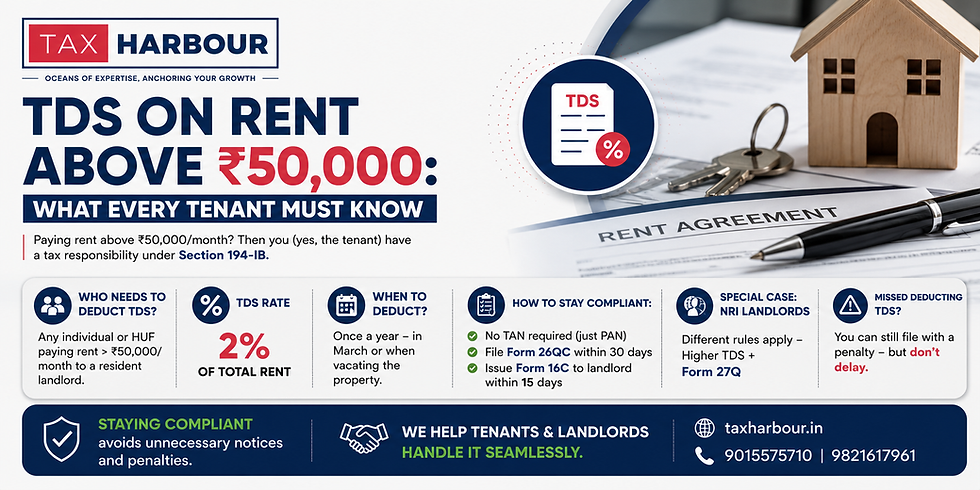
Paying rent of more than ₹50,000 a month? You may already have a tax obligation you are not aware of. Under the Income Tax Act, tenants — not just landlords — are legally required to deduct TDS before making high-value rent payments. Missing this step can attract interest, penalties, and even an income-tax notice.
Here is a plain-language breakdown of everything you need to know.
Which Law Governs TDS on Rent?
Two sections of the Income Tax Act deal with TDS on rent:
Section 194-IB applies to individuals and HUFs who are not liable for a tax audit under Section 44AB. If you are a salaried individual or a small business owner below the audit threshold and you pay monthly rent exceeding ₹50,000 to a resident landlord, this section applies to you.
Section 194-I covers all other persons — companies, firms, trusts, and individuals/HUFs who are subject to tax audit. For FY 2025-26, TDS under this section kicks in when annual rent exceeds ₹6 lakh (i.e., ₹50,000 per month), up from the earlier threshold of ₹2.4 lakh per year.
What Is the Current TDS Rate? (Updated After Budget 2024)
This is where many tenants go wrong by relying on outdated information.
Union Budget 2024 reduced the TDS rate under Section 194-IB from 5% to 2%, effective from 1st October 2024. So for most tenancies running through FY 2024-25 and beyond, the applicable rate is now 2% — provided the landlord has a valid PAN.
Situation | TDS Rate |
Landlord provides valid PAN – (Applicable for non-business tenants) | 2% (from 1 Oct 2024) |
Landlord does NOT provide PAN (Applicable for non-business tenants) | 20% |
Under Section 194-I (land/building) | 10% |
Under Section 194-I (plant & machinery) | 2% |
Important: TDS cannot exceed the amount of rent payable for the last month of the tenancy or the financial year.
When Exactly Is TDS Deducted?
Unlike most TDS provisions where tax is deducted monthly, Section 194-IB requires deduction only once a year, at the time of crediting or paying the rent for:
- The last month of the financial year (i.e., March rent), if the tenancy continues; or
- The last month of the tenancy, if the property is vacated before the financial year ends.
So, if you pay ₹60,000 per month in rent from April 2025 to March 2026, you deduct TDS only once — on the March 2026 rent payment — at 2%.--
Who Needs a TAN? (Good News Here)
Under Section 194-IB, tenants do not need a TAN (Tax Deduction Account Number). This is a deliberate simplification meant to ease compliance for individual tenants.
You only need:
- The landlord's PAN
- Form 26QC (challan-cum-statement for TDS on rent)
- Form 16C (TDS certificate to be issued to the landlord)
How to Deposit TDS on Rent?
Once TDS is deducted under Section 194-IB, you must deposit it using Form 26QC within 30 days from the end of the month in which the deduction was made.
For example, if you deduct TDS on March rent in March, the deposit deadline is 30th April.
After depositing, you must issue Form 16C to your landlord within 15 days of the due date for filing Form 26QC.-
What If You Don't Deduct TDS?
Non-compliance has real consequences:
- Interest for late deduction: 1% per month (or part of month) from the date TDS was due to be deducted
- Interest for late deposit: 1.5% per month from the date of deduction to the date of actual deposit
- Penalty for late filing of Form 26QC: ₹200 per day
- Possible income-tax notice — the IT Department has already issued notices to multiple salaried tenants claiming HRA without having deducted TDS.
Does TDS Apply If Landlord Is Not a Resident?
Section 194-IB applies only when the landlord is a resident Indian. If the property is owned by an NRI (non-resident), different provisions apply, specifically Section 195, and TDS rates and procedures differ substantially.
Practical Example
Ramesh, a salaried professional, pays ₹65,000 per month as rent for his flat in Lucknow throughout FY 2025-26. His landlord has a valid PAN.
- Total annual rent: ₹65,000 × 12 = ₹7,80,000
- TDS applicable: Yes (exceeds ₹50,000/month)
- TDS deducted: Once, on March 2026 rent = 2% of ₹7,80,000 = ₹15,600
- Net payment to landlord for March: ₹65,000 − ₹15,600 = ₹49,400
- Form 26QC filed and ₹15,600 deposited by 30th April 2026
- Form 16C issued to landlord within 15 days thereafter
A Note for Our Clients — We Are Here to Help
Navigating TDS rules can be confusing, especially when rates change or you are unsure about your obligations as a tenant. At Tax Harbour, we assist individuals, salaried employees, and businesses with accurate, timely TDS compliance so you never face an unexpected notice.
How Does This Affect Seafarers?
Many Indian seafarers who qualify as NRIs spend a significant portion of the year abroad but maintain rented accommodation in India for their families. Even though the seafarer's foreign salary is not taxable in India, the TDS obligation on rent is entirely a function of who is paying the rent, not the seafarer's NRI status. If a seafarer or their family member rents a property in India at more than ₹50,000 per month, TDS under Section 194-IB still applies and must be deducted, deposited via Form 26QC, and reported correctly. Failing to do so can invite IT Department scrutiny.



Comments